Kukumuty Becomes First Project Certified by Updated Carbon Standard
The Kukumuty project, led by the Mangunde and Nhaumue communities of Chibabava in Mozambique, has become the first certified project under version 5 of the Plan Vivo Carbon Standard (PV Climate V5). Launched in 2022, the project works to enrich the Miombo forests around Chibabava and enhance food security in the region.
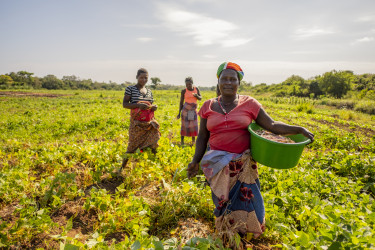
In the Chibabava District of central Mozambique, the Nhaumue and Mangunde communities are working to enrich the Miombo forests and fight hunger by building more resilient local food systems. Miombo forest is a tropical woodland ecosystem rich in biodiversity. It covers roughly 10% of the African continent and supports nearly two-thirds of rural livelihoods across this part of Africa. However, this complex ecosystem is under threat. Changing climate patterns, combined with growing economic stress for rural households, has increased pressure on miombo woodland resources, endemic biodiversity, and local ecosystem services.

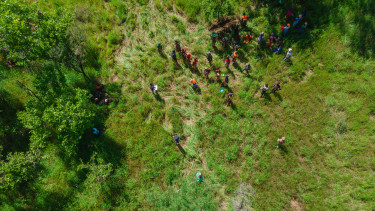
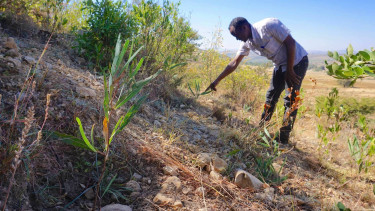
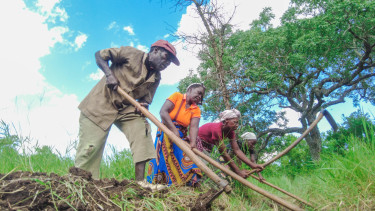
The Kukumuty project, which works over 369ha and takes its name from the Ndau phrase ‘Kurarama Kuthemba Muty’ (translation: ‘we live and hope because of the trees’), aims to alleviate this pressure. The project establishes Miombo and agroforestry nurseries and plots for growing horticultural species. This includes a combination of fruit, nut, medicinal, and other useful native trees (including Albizia, papaya, mango, orange, avocado, and moringa) and a sustainably harvested collection of grasses, honey and indigenous Miombo fruits.
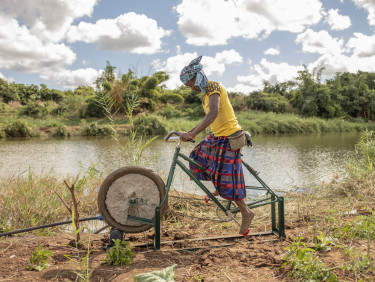
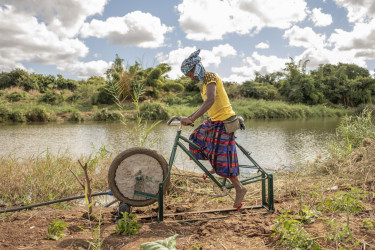
These interventions build on the in-depth knowledge and expertise of rural communities to create more resilient agroecosystems and introduce alternative and sustainable livelihood opportunities for local people. In addition, simple but innovative and effective tools are being deployed to tackle food insecurity and improve yields. One of the most effective tools are the ‘bicibombas’, specially adapted bikes that create a manual water pump for farm irrigation simply by pedalling. This low-cost irrigation system ensures low-income families have year-round access to irrigation which enables improved crop yields.
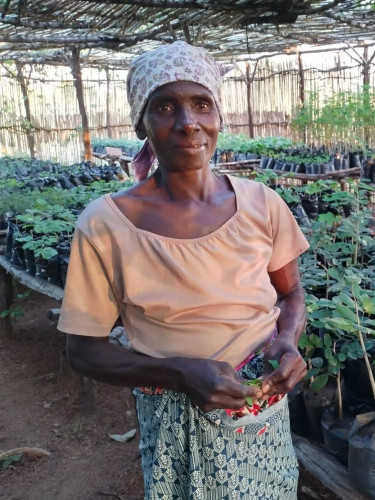
For Gloria Fernando, a nursery worker at Nhaumue, the project not only improves soil fertility, but also supports her and her family by providing job opportunities in the local nursery:
”I am very satisfied that the project has implemented the agroforestry system, as with these climate changes, it can improve soil fertility. Additionally, I managed to get a job [in the nursery] to support my children, as I am a widow and responsible for providing for my children’s education and food.”
From a climate and biodiversity perspective, Kukumuty’s interventions seek to increase floral diversity by establishing greater numbers of endemic Miombo species — which also boosts carbon sequestration. Carbon removals are currently estimated to be in excess of 74,000tCO2e throughout the project’s lifetime, with the carbon finance generated (through the sale of Plan Vivo Certificates or ‘PVCs’) being reinvested by the communities in social projects such as apiculture, schooling, and water infrastructure.
I am very satisfied that the project has implemented the agroforestry system, as with these climate changes, it can improve soil fertility. Additionally, I managed to get a job [in the nursery] to support my children, as I am a widow and responsible for providing for my children's education and food.
Achieving PV Climate certification
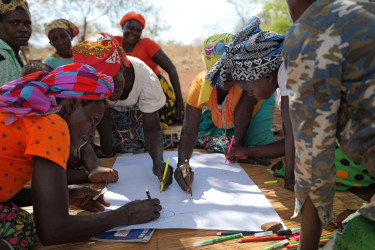
The project is a result of the collaborative efforts and dedication of the Nhaumue and Mangunde communities, project developers Climate Lab, local partners Reseed Indico, and NGO partner Azada Verde.
For Climate Lab, Kukumuty is not their first Plan Vivo ‘gig’ so to speak. The Climate Lab story started with years of research at Ghent University, studying the impact of climate change on the local livelihoods and ecosystems in the North-Ethiopian Highlands.
In 2016 EthioTrees came into existence — a small reforestation project located in the steep hills of the Tembien Highlands. Roughly a year later, EthioTrees achieved Plan Vivo certification. Due to community interest, the project grew organically, and in 2021 Climate Lab started to disseminate the EthioTrees model to Mozambique (Kukumuty) and Madagascar (Voa Aina).
Fast forward three years and Kukumuty is now a fully certified PV Climate project (officially registered in May 2024). In addition, Kukumuty also becomes the first project to be certified beneath PV Climate V5. This updated version of the Plan Vivo Carbon Standard was developed in response to emerging best practice within the VCM and was officially launched by Plan Vivo in 2022.
Periodical updates of Plan Vivo Standards aim to incorporate the Foundation’s experience and progressive knowledge of project development, project marketability, and the changing landscape of environmental markets. For prospective and pipeline projects in the process of developing and implementing PV Climate requirements, V5 of the Standard provides an opportunity to take advantage of standardised methodologies and improved environmental and social safeguarding procedures.
The newly attached PVC unit types have been designed with the aim of improving clarity to resellers and buyers purchasing PVCs (and making subsequent climate claims), whilst ICROA endorsement of the Standard means projects have access to a wider market of responsible buyers.
Project Perspectives: An interview with Project Developer Climate Lab
With the benefit of developing a PV Climate V4 (Ethiotrees) and V5 project (Kukumuty), what differences have the Climate Lab team found between the two Standards? What opportunities and challenges do they foresee for Kukumuty as a registered V5 project?
They tell us more in the interview below.
How are you feeling about Kukumuty being officially Plan Vivo-certified?
The project started its very first initial meetings in 2021. In 2022 we won a VIKAP climate action grant to cover the start-up costs on the ground. We hired team members and set up the first nurseries. So finally, roughly three years after its birth, we are very happy to get PV Climate certification. It means the very tiny young project we started has proved to now be strong enough to survive and to start growing.
What does certification mean for the communities and ecosystems involved in the project?
We believe it provides both socio-environmental funding and quality of working. First, Plan Vivo sets the bar to share at least 60% of the carbon benefits with the communities. This is a good thing, as we see it boosts enthusiasm in the communities to foster Miombo enrichment. Second, PV Climate gives us a guiding track to help us design the project in a sound way. The Standard will guide us over the coming years, and make sure we remain on track during the next 30 years. For us, it helps to be able to use the PV Climate to ensure best practices, to streamline processes, and to follow the Standard’s benchmarks to obtain a real level of quality.
What challenges did you face when developing Kukumuty?
Finding start-up funding is not easy: it involves a lot of grant writing. We finally found it in VIKAP. The logistics of running a project in Chibabava (five hours driving from Beira) is challenging: luckily the project director Samuel Sibanda is an incredible driver. And finding the right team members has been key: currently we have a magnificent team on the ground!
Why do you think updating Plan Vivo Standards is important?
To stand still is to go backwards: it is good news that Plan Vivo looks to the future. We believe under V5 there are more safeguard mechanisms for communities: e.g. we think that the E&S Risk Assessments can be very valuable to improve the project design in the first phases. Also, for buyers, there are even more safeguards in V5. We have noticed that ICROA buyers have become increasingly interested in our projects. We feel that with V5 we can attract a bigger international market. More safeguards, more buyers and higher prices will not weaken, but strengthen, the community core benefits.
What are the differences that you (as project developers) have found between the two versions of PV Climate (V4 and V5)?
In general, V5 has much more guidelines. On the one hand, you are a bit “less free” to develop your own methodology and the process is slower. On the other hand, you have many more guidelines to take you along the (difficult path of) certification and project development. We particularly liked the E&S risk management because you are forced to re-evaluate your project right at the moment when you thought it was well-designed. Through organising these extra risk community meetings, you find further elements that can improve the project design.
What challenges do you see for PV Climate V5 certified projects?
Long validation timelines are one thing. Another thing is that you cannot directly retire fPVCs nor rPVCs from the registry: you must wait until these become vPVCs. With this in mind, we think buyers will need some extra “education” if they really want scarce high-integrity removal credits, they will have to be more open in an evolving market. This is the way to really help and fund impact on the ground.
What are the opportunities for Kukumuty as a V5 certified project?
We are looking forward to the first sale, which will also be the very first sale of these new V5 PVCs, and we cannot wait for the first social funds to begin flowing back to the community.
Finally, what advice might you give to project developers who are currently, or may be looking to develop a PV Climate V5 project?
Take your time, at least 2 to 3 years. Start the design with community meetings and end the design with community meetings. And try to do the E&S risk planning early on during the design, that will help a lot. Overall, it is more work to develop a project along V5 as compared to V4. But it should increase both community confidence and buyer confidence and thus boost prices for these high-integrity removal credits, so in the end we will all benefit.
What next for Kukumuty?
For Hugo Coll Dalmau, Azada Verde’s Director, reaching PV Climate certification stage encapsulates three years of hard work and a long journey:
It's very exciting that the Kukumuty project is now fully certified beneath PV Climate. Plan Vivo certification will allow the project to have continuity and sustained growth over time. Changes take time, especially ones of this nature, because we are directly impacting people's lives and ecosystems and that doesn't happen overnight; it's a long journey. Certification will enable local families to break free from the annual cycles of hunger they experience, generating opportunities and livelihoods for current and future generations whilst caring for their ecosystems.
Over the coming years the project will focus on expanding agro-ecosystem mosaics, increasing livelihood opportunities (through the sale of fruits, nuts, miombo fruits, honey, and other related produce), and safeguarding crucial biodiversity in this important Miombo hotspot. It is also hoped (alike the EthioTrees project) that Kukumuty will upscale naturally through organic community interest and the inclusion of additional neighbouring communities.
Plan Vivo would like to congratulate Kukumuty for achieving PV Climate certification and being the first registered V5 project. We look forward to seeing how the project progresses.